Flanders Literature helps publishers and festival organisers find that one particular title or author that is the perfect fit for their list or audience. So take a good look around, we present a selection of the finest literature from Flanders. If you like what you see, please get in touch with us for further information.
Distinctly innovating poetry resulting in a whirling reading experience
Literaire Canon
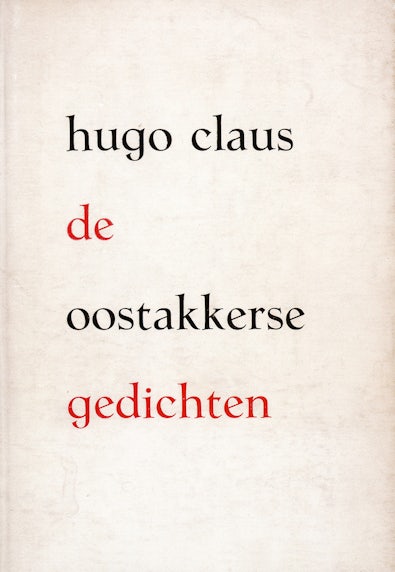
Using old myths of fertility described by Frazer, biblical and Christian references and literary quotations, Claus evokes a mythical and fatal family constellation in which the mother, the father, the son and the beloved play roles that are alternately driven by desire and love, but also by fear and hatred. Definitely one of the highpoints in his oeuvre.
One of the purest realisations of the therapeutic novel
Bernard Kemp
One day while looking in a mirror Henri sees deterioration in a body that is no longer his. He undergoes a beauty treatment before entering into the ultimate confrontation with himself, arising from the ashes as a handsome young man. But this ‘purification’ is a vain attempt at camouflaging a life built on lies and deceit.
In ‘Minuet’, a man works eight hours a day in the deep-freeze basement of a factory. In that polar world he is accompanied only by his own fears and thoughts, and for hours on end he has conversations with himself. The neurotic protagonist poses critical questions about religion, monarchy and the State.
A fast-paced and nuanced story, a strong indictment of the exploitation of the child
NBD Biblion
A young girl from a working-class family gets up early for her first day at the brickworks. This first day at work means both the end of her childhood years and her ‘initiation’ into adult life. She makes her first acquaintance with the gruelling work, the brutality of the workers and the tyranny of Krevelt, the dreaded boss. She can see only one way out: the young love that blossoms between her and an apprentice. But will that be enough of an anchor to keep her from drifting into the danger that fate is mercilessly pushing her towards?
One of the few truly magnificent novels in Dutch language-literature. A masterpiece.
De Volkskrant
This novel tells the story of Ondine, who was born in a poverty-stricken house in Chapel Road at the turn of the twentieth century. The Times Literary Supplement wrote: 'Since its original appearance in 1953, this novel by the candidate for the Nobel Prize has been controversial as only works in advance of their time can be; and even now that experimental writing is commonplace, it has lost none of its freshness and vitality.'
His is some of the most exquisite work to be found in Dutch.
Het Vaderland
‘Winter in Antwerp’ is the singular follow-up to Gilliams’ ‘Elias or the Struggle with the Nightingales’. Elias now having lost his mother and spent months in hospital, is walking to his elderly father’s house. In brief, associative, yet carefully composed chapters, the narrator examines his past, his obsessions and his fears.
‘The Battle with the Angel’ tells of the life of a community, spread over several generations, but primarily between the world wars. The work bears witness to an unbridled creative force masterfully endeavouring to portray the contrast between primeval nature and decadence. Teirlinck never moralises or lectures, but is majestic and full of compassion for his characters.
‘Lament for Agnes’ is essentially an autobiographical novel. The character of Agnes is in many respects that of Gijsen’s own fiancé who died of TB, while the narrator has much in common with the authors as a young man. ‘Lament for Agnes’ is a novel that is once deeply personal and a fully independent work of art.
After a mysterious journey in a train populated with sleeping passengers, three train travellers find themselves in a strange, shadowy land, a timeless transition area, to which each responds in his own way.
'The Duck Hunt' is the story of a Flemish farming family during World War II. The centre of the family is the widow Metsiers, who is called ‘the Mother’. Years ago, she murdered her husband, together with her lover Mon Verkindere, with whom she now lives on the farmstead. She has two children: Ana and Bennie. Bennie and his half-sister are driven ever closer together, until a love grows between them for which Bennie eventually has to pay the price.
At the end of his life and in the first two decades of the 20th century, Gezelle was hailed by the avant-garde as the founder of modern Flemish poetry, and his unique voice was also belatedly recognised in the Netherlands and often compared with his English contemporary Gerard Manley Hopkins.
A mix of acutely observed human passions and surrealist contradictions
Dietsche Warande en Belfort
Teacher Govert Miereveld becomes enchanted by his pupil Fran. Unable to express his love, he leaves the school and changes both his job and hometown. Ten years later he attends an autopsy, which affects him a great deal. Later that day, he also runs into Fran in the hotel where he is staying. That night, he visits her in her hotel room, where a drama unfolds.
A finely tempered piece, with an intuitive sympathy for strange modes of feeling
The Times
‘Will-O’-The-Wisp’, the last of Elsschot's novellas, tells the story of the nocturnal search by the rather washed-up Frans Laarmans and three Afghan sailors for the mysterious Maria van Dam. The simple plot of a fruitless search in an urban setting contains undertones of a wider parable of the quest, thus making a concentrated summary of the themes that run through all Elsschot’s novels.
A literary all-rounder who explores all facets of life
De Volkskrant
‘Pitfalls’ is a varied collection of letters, verse and short stories. The excerpts from the letters – which were never intended to be made public – caused a furore at the time. The title refers to the obstacles between Minne and the process of writing, between the author and publication – in other words, to the aforementioned struggle. As Minne put it: ‘Caution, enter at your peril!’
An enthralling creation myth with almost biblical appeal and ambition
De Morgen
In ‘Houtekiet’, Walschap gives a concise, powerful portrayal of his own ideal of the individual and society. ‘Houtekiet, that’s me,’ he admitted. This is a novel about civilisation and faith that goes beyond the traditional differences between culture and nature, between institutionalised religion and individual vitalism.
Elsschot possesses the rare knack of making a reader laugh, squirm and sob, all at the same time
The New York Times
The novellas ‘Soft Soap’ (1924) and ‘The Leg’ (1938) are two highlights from Elsschot’s fiction, linked by a common narrative and featuring the recurring tragicomic Keatonesque character of Frans Laarmans who also appears in Will-o’-the-Wisp (1946).
In a series of fascinating scenes, Gilliams evokes the vulnerable position of a boy growing up amongst older people in a world shaped by nostalgia and the fear of life. Elias perceives that world ‘in the lucidity of a dream’. The precision of observation and narrative evocation is what makes ‘Elias’ such a masterpiece.
‘Novellas that attempt to make a fool of people,’ is how Paul van Ostaijen once described his grotesques. In these astonishing texts full of absurd blow-ups, he lashed out against the wrongs of his time, mercilessly unsettling all logic.
Streuvels is the Tolstoy of the Lowlands. Magisterial.
David Van Reybrouck
This story gives an inimitable description of the monotony and finiteness of life against the backdrop of a drunken, nocturnal atmosphere in which dream and reality are masterfully interwoven. With this novella, bathed in a magic-realistic atmosphere, Streuvels has written one of the loveliest short stories in Dutch literature.
‘Whitey’ by Ernest Claes is a picaresque novel about youthful escapades and growing up. Set in the village of Zichem in De Kempen, the Flemish region where both the author and his character were born, it is one of the prototypes of the immensely popular regional novel. The story of the hero’s childish pranks is a classic of Flemish literature, which has been adapted for the big screen on two occasions.
Maybe it’s the finest thing by Van de Woestijne that we have
Martinus Nijhoff
Evening falls, it grows dark, the peasant Nand is lying alone in bed and is cold. Scraps of his life flash by his mind’s eye. ‘The Dying Peasant’ isn’t just an anecdotal peasant novella, but a symbolic tale that excels in its simplicity.
Streuvels is the Tolstoy of the Lowlands. Magisterial.
David Van Reybrouck
‘The Flax Field’ is constructed as a classic tragedy, and tells of the tragic conflict between father and son Vermeulen. The father rules over his entire farm as an authoritarian patriarch. But Louis, his almost grown up son who has quite a bit of insight into farming, thinks differently.
In ‘The Van Paemel Family’, Cyriel Buysse addresses the social exploitation and immense poverty of the rural population. Buysse paints a picture of how the farmer becomes ruined and his family falls apart as a result of socioeconomic conditions. Although Buysse offers no solutions to the conflict, there is still a glimmer of hope.